
Adenty vs Traditional Tracking: 3× More Warm Audiences and 2× Deeper Visitor Profiles

Many conversion optimization insights feel predictable, yet one factor remains surprisingly overlooked. It strongly influences how effectively you convert your warm audience, how well you identify website visitors, and how confidently you personalize and scale engagement. This factor matters for any business that relies on a website or web app to sell, including Media and Publishers, MarTech and AdTech platforms, eCommerce, EdTech, Booking Services, Agencies, SaaS, and Gaming.
Let’s walk through it step by step.
Section 1: Most website visitor tracking systems miss a large share of your engaged audience
It is always easier to convert someone who already knows your brand. Returning visitors come back intentionally, which means they are much closer to making a decision than first‑time explorers. In theory, this should be the easiest audience to understand. In practice, even major website visitor tracking tools fail to recognize up to 67% of returning visitors, so two-thirds of your warmest audience is treated as new every time they return.
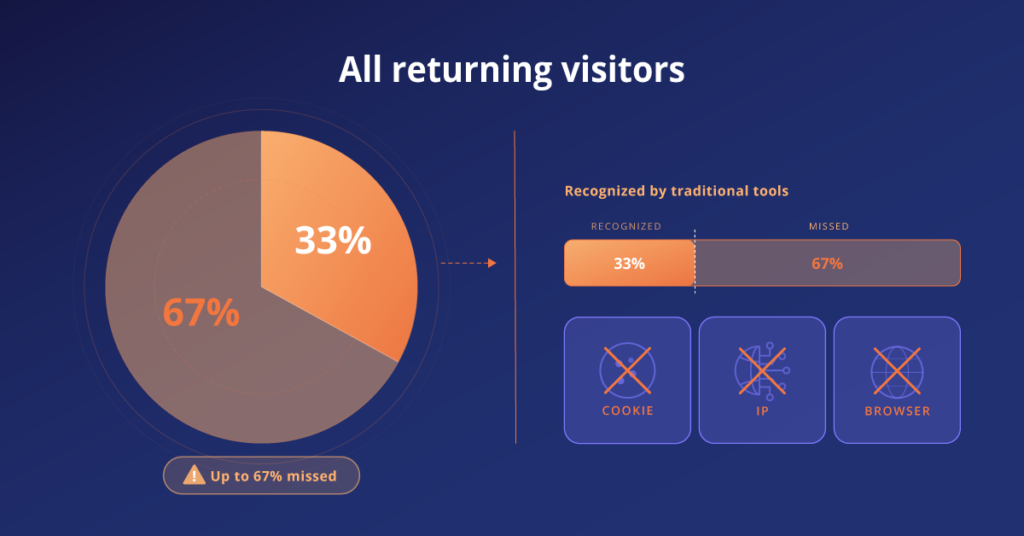
This leads to fragmented profiles, inaccurate analytics, and missed opportunities for personalization and targeting. Businesses that try to track website visitors often discover that their tools collect only short-term data, which limits their ability to understand intent. Even website visitor monitoring software struggles to maintain continuity when cookies disappear or devices change. As a result, companies lose visibility into their most valuable segment, which makes warm audience tracking significantly less effective.
Key takeaway: New visitors explore. Returning visitors intend. Most analytics platforms fail to recognize them, which shrinks your pool of easy conversions.
Section 2: Returning visitor recognition — the hidden metric that shapes your marketing ROI
Among familiar metrics like unique visitors or session duration, returning visitor recognition is the one that quietly determines how much of your traffic your tools can actually see. Most visitors do not convert on their first visit. They return days, weeks, or months later. Each return should strengthen their intent, but only if your system can connect all their visits into one identity.
The depth of your data depends on how long your tracking system can recognize the same person. This is where traditional website visitor tracking breaks down. A visitor arrives and the system creates a profile. After a few sessions or days, the system loses track of them. Their next visit is treated as a brand‑new user. This creates shallow, short-lived profiles that are not useful for segmentation, personalization, retention, or any meaningful engagement.
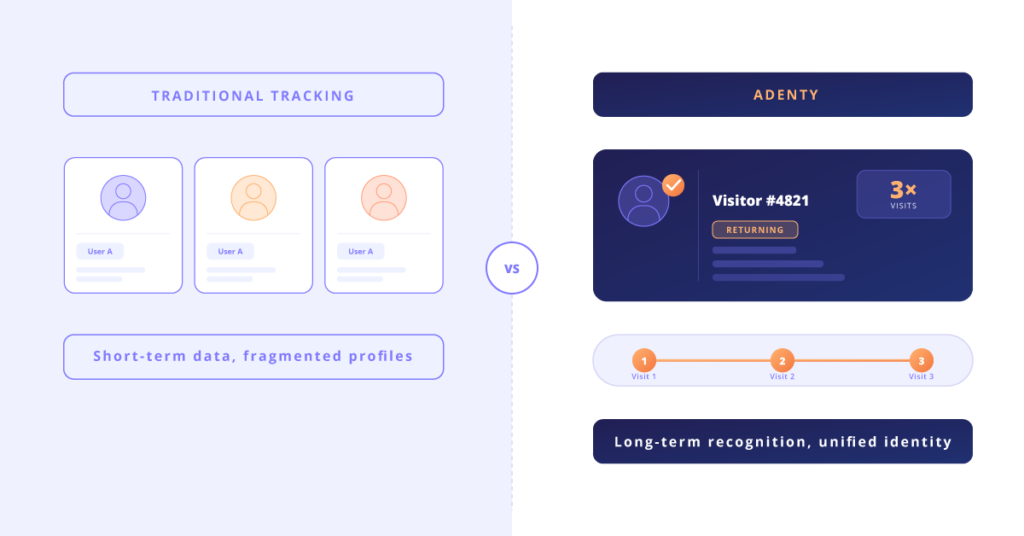
Many companies try to fix this by adding another visitor tracking tool, or by experimenting with website visitor identification tools, but these solutions still rely on fragile identifiers. Even the best tool to identify website visitors cannot perform well if it depends on cookies or IP addresses. To build long-term continuity, businesses need stronger methods, such as identity resolution software, which connects data across sessions, devices, and environments.
Key takeaway: Without long-term recognition, visitor profiles stay thin and disconnected, which limits your ability to convert.
Section 3: Why returning visitor recognition is the weak point of most tracking systems
Most widely used tracking methods rely on cookies, IP + User Agent, or session-based logic. All three approaches break down for predictable reasons. Browsers delete cookies, users clear them, and privacy tools block them. People switch devices and browsers, which fragment identities. Dynamic IPs and shared networks make multiple users look identical. VPNs, incognito mode, and privacy browsers hide identities entirely.
This is why even advanced setups struggle with anonymous website visitor tracking. Tools that focus on short-term sessions cannot maintain continuity over time. Companies that rely on website visitor behavior tracking tools often discover that their data becomes fragmented after only a few days. Even the best website visitor identification software cannot overcome architectural limitations if it depends on identifiers that disappear quickly.
One of our clients, a U.S. newspaper publisher, fixed this issue and increased monthly revenue by up to 15%.
Key takeaway: Tools like Google Analytics, cookies, and IP-based tracking collect short-term data, which makes engagement short-sighted and costly.
Section 4: Who delivers better visitor recognition? Comparing Adenty, Cookies, Google Analytics, IP + User Agent
You’ve already seen how poor recognition affects revenue. We’ve observed this pattern across many industries, which is exactly why we built Adenty. Our goal is to help businesses uncover warm audiences that traditional tracking methods simply cannot see, and to provide the tools needed to strengthen engagement and grow revenue.
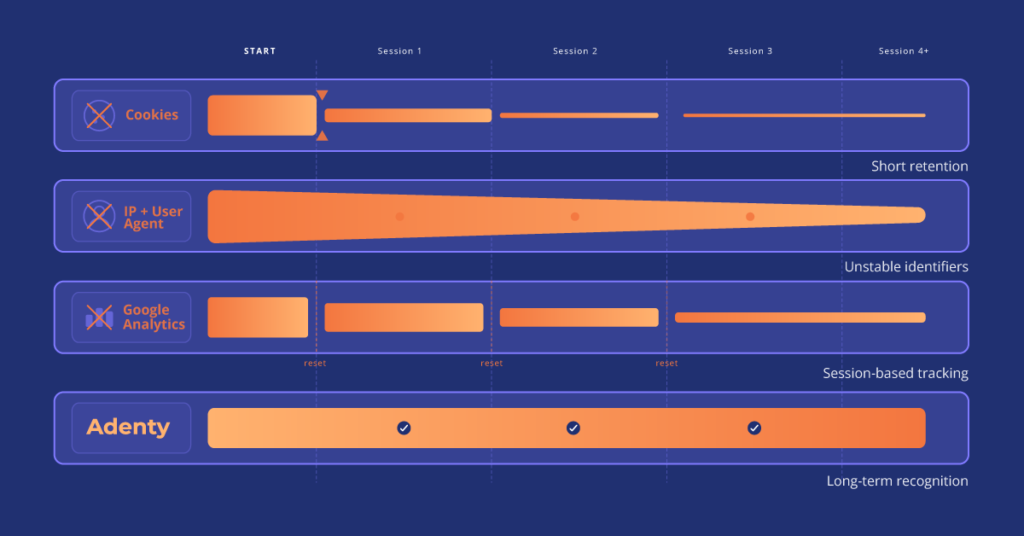
To understand how much better Adenty performs, four clients agreed to run Adenty alongside three rival tracking methods: Google Analytics, cookies, and IP + User Agent. For one month, all systems worked in parallel. Afterward, we compared three core metrics that directly influence marketing ROI:
- Returning Visitors Volume — how many more returning visitors Adenty recognizes compared to other methods.
- Visitor Recognition Duration — how much longer Adenty keeps visitors recognized.
- Tracking Volume (Pageviews) — how many more pageviews Adenty detects compared to Google Analytics.
Across Media and Publishing, AdTech, SaaS, and Software Services, the results were consistent:
- Up to 3.2× more returning visitors recognized
- Up to 2.8× longer recognition duration
- Up to 1.3× more pageviews detected
These findings show that traditional tools cannot match the performance of a modern website visitor tracking platform designed for long-term continuity. Many companies searching for the best user tracking tools eventually discover that short-term identifiers limit their ability to understand intent. Teams that need immediate behavioral insights also benefit from real-time website visitor tracking, which helps them react to high-intent actions the moment they happen.
Key takeaway: Compared to Google Analytics, cookies, and IP + User Agent, Adenty uncovers up to three times more returning, high-intent audiences, maintains 99% recognition accuracy even in private browsing environments, and builds significantly richer visitor profiles.
Recognition does not equal conversion, but it makes conversion possible
Recognition alone does not convert. However, without it, personalization, targeting, and engagement simply cannot work. With Adenty, you also get instant reactions to target visitor behaviors, multi-step engagement flows across your MarTech stack, unified visitor identities across all your data sources, and fast installation that works with any web solution.
Final thoughts
Trying to engage visitors without proper recognition is like looking at a reflection in a broken mirror. You only see fragments. With accurate, long-term recognition, you finally see the full picture and can act on it.
If you want stronger recognition and more data-driven engagement, try it for free or write to contact@adentypro.com
It is the ability of your tracking system to recognize visitors over time and build a continuous profile instead of resetting it.
Traditional tools miss up to two-thirds of returning visitors because of cookies, privacy tools, architecture limitations, and device switching.
Yes. One client increased monthly revenue by 15% after improving recognition.
It is not everything, but it is the foundation. Without it, personalization and targeting cannot work.
