
Build 2x deeper profiles with Adenty
Capture data for both anonymous and authenticated audiences. Connect signals with a persistent ID. Make data activation your platform’s value point
What weakens platforms’ data quality
Here’s why collecting identity-rich data remains an unresolved challenge for data platforms
01
Multiple tracking frictions
Cookie resets and browser data fragility, ad blockers, Intelligent Tracking Prevention (ITP), and unstable identifiers — all drain data volume and fragment profiles
02
Low data match rates
Heterogeneous marketing stacks lack data connectivity and require complex integrations or manual effort to unlock a unified visitor view
03
Anonymous audiences
More than half of audiences are not logged in. VPNs, incognito mode, and private browsers further limit audience data collection and segmentation
Enable precise data capture and activation right in your platform
Collect advanced audience data and activate it — Adenty lets your platform do both despite tool silos and tracking gaps
Never Miss
a Returning Visitor
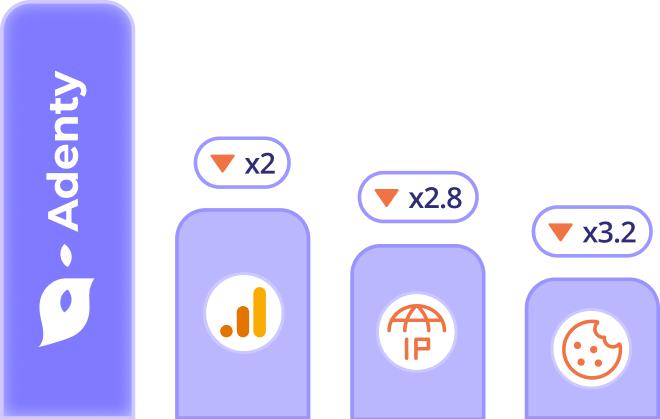
New visitors explore, returning ones convert. Yet most analytics lose track when visitors come back. Adenty reveals them with superior 99% precision, unlocking more of your engaged audience — just compare.
Returning Visitors Volume
New and Returning Visitors Differentiation
Visitor Recognition Duration
Page Views Detected
Higher precision up to
x2
vs Google Analytics
x2.8
vs IP + User Agent
x3.2
vs cookies
Why Adenty
After a plug-and-play integration with your data platform, Adenty strengthens audience data collection, enrichment, and connectivity without impacting performance
99%
Accuracy in recognizing returning visitors
Zero
Zero impact on frontend performance
Easy
Integration with your tech stack
Flexible
Licensing and pricing
GDPR
Compliant with secure
EU- and U.S.-based cloud infrastructure
Support
Throughout your journey
All Adenty Solutions for
Data Platforms
Create flexible combinations of Adenty solutions to boost data collection, integration, and actioning
Case studies
See how customers achieved sharper data and measurable growth powered by Adenty
Let ChatGPT, Claude, or Perplexity analyze it for you
Frequently Asked Questions
A data platform is a technology foundation for collecting, storing, connecting, processing, and using data across different systems. It can bring together website events, behavioral data, customer records, and other sources so teams have a more connected view of their data.
For platforms dealing with anonymous audiences, persistent identity can also help connect activity before someone logs in. Adenty adds this visitor-level layer to the wider data environment.
Data platform architecture describes how data moves through a platform, from collection and storage to processing, identity, orchestration, and activation.
The exact setup depends on the use case. A website-focused platform, for example, may need real-time event processing and identity resolution to connect activity across sessions and systems.
A data lakehouse combines capabilities associated with data lakes and data warehouses. It can store large and varied datasets while supporting analytics and structured reporting from the same environment.
A lakehouse can be a good fit when teams need flexibility across different data types and workloads. Whether it makes sense depends on the existing stack, data volume, governance needs, and analytics requirements.
Need to see where Adenty fits into your setup? Book a 30-minute demo.
Sometimes, yes. A data lakehouse can handle many workloads traditionally associated with data warehouses, but the right choice depends on the organization's data, performance needs, architecture, and existing tools.
Before replacing a warehouse, teams should look at:
- Current analytics workloads
- Data governance requirements
- Performance and cost
- Existing integrations
A lakehouse can simplify some environments, but there is no one-size-fits-all architecture.
Data fabric is an architectural approach for connecting and managing data across different sources, systems, and environments. It combines technologies such as integration, metadata, and automation to make distributed data easier to access and work with.
For website data, the same principle can help connect activity across websites, tools, and touchpoints. See how Adenty connects visitor data across your stack.
Start with the data sources and business use cases you need to support. Then design the platform around collection, storage, processing, identity, integrations, and activation.
A practical starting point:
- Map your data sources and signals.
- Decide how data should be collected and stored.
- Define how identities will be connected.
- Connect the tools that need the data.
- Add real-time processing where the use case calls for it.
Prefer to see how the whole thing works? Start with the Adenty User Guide.
