
Identity Resolution
Turn fragmented user signals into one stable identity
Many companies invest in traffic and data, yet they still struggle to understand who returns to their site. The Adenty Identity Resolution Toolkit gives you a stable and accurate way to recognize visitors across sessions, devices, and websites. The plugin continues to work when cookies fail or when browser storage resets. You get a dependable identity layer that improves analytics, personalization, and audience targeting.
No complex integration required
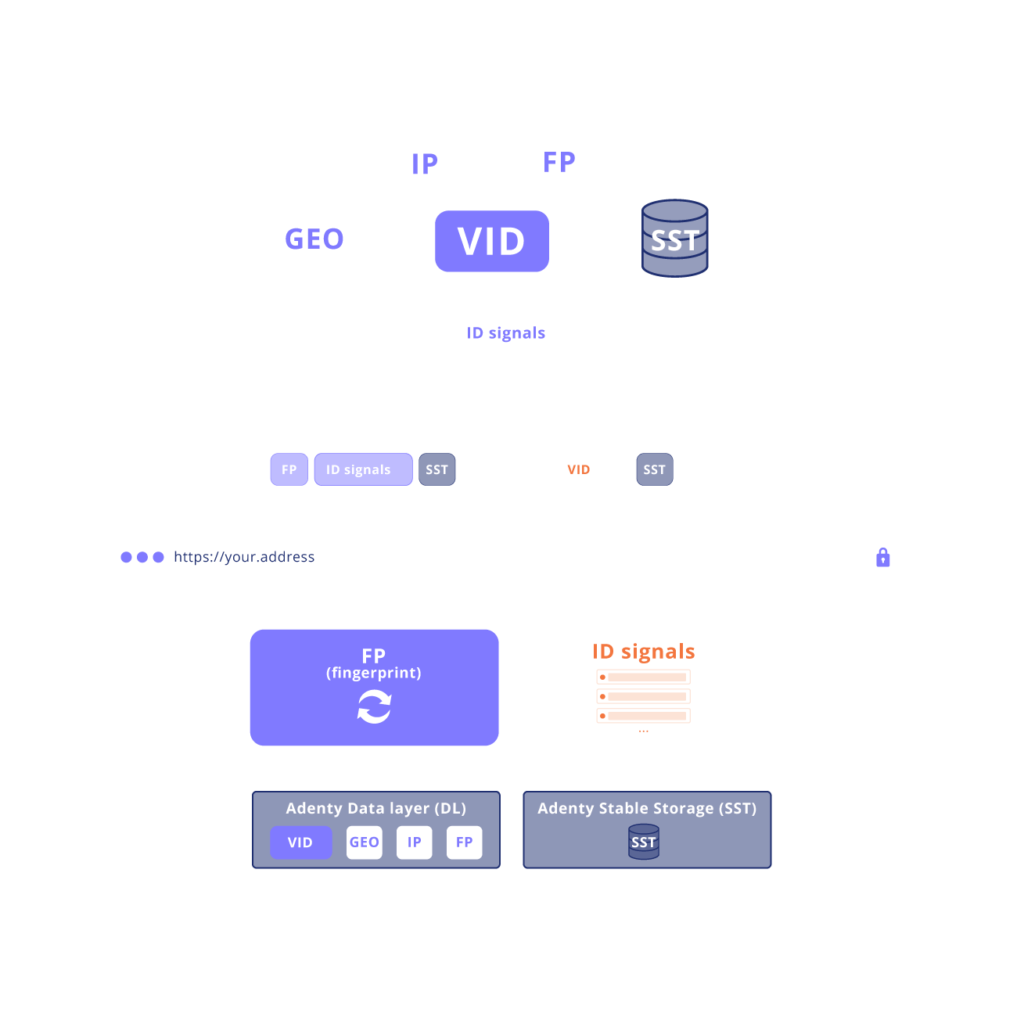
Three Traps to Unified Identity
01
Session Instability
Most identity resolution tools lose track of users after a few sessions. Cookie blocks, VPNs, incognito mode, and private browsers interrupt continuity. This reduces match rates and limits how much data you can actually use.
02
Multiple Websites and Devices
Users switch devices and browse across different websites. Traditional identity resolution software cannot connect these signals. This splits a single user into multiple incomplete profiles.
03
Disconnected Tools
MarTech tools generate isolated datasets that do not align. Merging them is difficult and often reduces data quality. This prevents you from building a complete identity graph.
Unified Identity Across Every Data Source
Adenty removes identity fragmentation at every level. The persistent ID becomes a stable foundation for analytics, personalization, and audience activation. You can collect, connect, and retain user data across websites, devices, and tools with high accuracy.
Adenty assigns a unique ID to every new visitor. All future activity is linked to this ID, which stays stable across sessions and websites. Cross-device recognition works through signal-based attribution, where actions from different devices are matched to the same user. These signals can be configured individually. This stability ensures that identity continuity remains intact even when user behavior spans multiple domains and touchpoints.
The Persistent ID also supports ID bridging, which lets you merge data from your MarTech tools into one connected profile. It remains active even when browser storage is blocked or cleared.
Most analytics tools depend on browser storage, which can be blocked or wiped at any moment. Adenty Stable Storage protects your data from these losses and keeps your analytics consistent. Local storage is used by default, while a backup copy is kept in Stable Storage. When browser storage disappears, the system restores the data automatically, so your analytics stay accurate.
Adenty Stable Storage can also read the existing data you already keep in the browser and understand its structure. It keeps a secure backup of this information and restores it when it detects that the original data is missing. You can also store any behavioral data or events you choose to preserve. No more lost or misattributed visitor data. Everything stays protected and under your control.
A Stable Layer for Personalization, Targeting, and Data‑Driven Marketing
Adenty strengthens the core of your data strategy. It gives you accurate recognition and stable tracking that support every part of your marketing workflow.
Identity-rich
user data across sources
Fine-tuned
personalization
Granular
segmentation and targeting
Increased
audience addressability
Accurate
web analytics
Minimized
data duplication and gaps
Adenty in Numbers
Explore Other Solutions
Upgrade Your Data Control Instantly
Adenty builds deeper user profiles and supports audience engagement through your existing ecosystem. You stay in full control with no heavy implementation.
Let ChatGPT, Claude, or Perplexity analyze it for you.
Case Studies
Read how our real clients turn insight into Performance.
Frequently Asked Questions
Adenty combines six signal types: technical attributes, behavior, device and server metrics, deterministic signals, probabilistic matching, and partner enrichment.
All six feed the Adenty ID Graph, a system connecting stable identifiers (ones lasting across sessions) with temporary ones (ones expiring quickly). Session signals add further context. Recognition accuracy reaches up to 99%, including where traditional identifiers are limited. Try it for free.
Adenty weighs multiple signals together, so no single identifier decides the outcome.
The ID Graph combines stable and temporary identifiers with configured session signals, and applies probabilistic matching to edge cases. Temporary identifiers count only within the time range where they stay reliable. Visitor identity holds consistent when individual signals go missing or turn unreliable.
Yes. Adenty restores identity after cleared cookies, local storage, or cache through Adenty Stable Storage and server-side logic.
Identity keys and stored attributes stay consistent independently of the browser. Recognition continues in privacy browsers such as Tor and Brave, and in environments where browser storage is fully disabled.
Adenty reports visitor type in its data layer alongside the stable Visitor ID, so returning activity separates from a first visit.
The returning-visitor signal can be sent to Google Analytics for analysis and segmentation. In recent client analytics, Adenty recognized 2.7× more returning visitors, delivered 1.6× better overall recognition, and held recognition 2.3× longer than cookies or IP-based methods.
Yes. Adenty opens a visitor profile before identification, then links it to a known identity once the visitor signs in or shares data.
Real-time events and session interactions combine with identity data from connected sources, so the profile grows richer over time. PII enrichment is opt-in under client agreements, and clients control enrichment, consent flows, and data residency. Auth integration ships out of the box, with additional Auth providers available through custom development for Enterprise customers.
