
What Publishers Don’t Know About Paywall Bypass and How to Stop It

Every time a reader hits your paywall and reopens the same article in a private tab, you lose a potential subscriber. Your analytics show nothing unusual. The visitor looks like a first-time user. The meter resets. The session closes.
Research found that 11% of all paywall stops end in a successful bypass. For a publisher with 500,000 monthly paywall impressions, that’s 55,000 missed conversions every month.
This guide covers how readers bypass paywalls, why most paywall architectures can’t stop it, and what you can actually do about it.
What Is Paywall Bypass?
Paywall bypass (also called paywall evasion or circumvention) happens when a reader accesses premium content without subscribing. It’s different from a bounce. These readers want your content. They just refuse to pay for it, so they find a technical workaround instead.
Most publishers track conversion rate. Very few track evasion rate: how many non-converting sessions were active bypasses rather than genuine exits.
What Makes Paywall Evaders Different from Regular Bouncers?
Direct intent. They arrive from typed URLs or bookmarks rather than social or search. They sought your content out by name.
Repeat behavior. They return on multiple visits. These are not one-time readers who stumbled in from a headline.
High-value content preference. They over-index on opinion and analysis, the editorial that sits behind most meters.
These three signals together mean paywall evaders look like your most loyal readers in every metric except one: they never convert. Standard analytics won’t flag that gap because the sessions appear identical to genuine new visits.
They are in fact among your most engaged readers. According to survey of 1,000 U.S. adults, 3 in 5 internet users actively avoid sites they know have a paywall, meaning publishers lose traffic long before the meter even fires.
How Readers Bypass Paywalls?
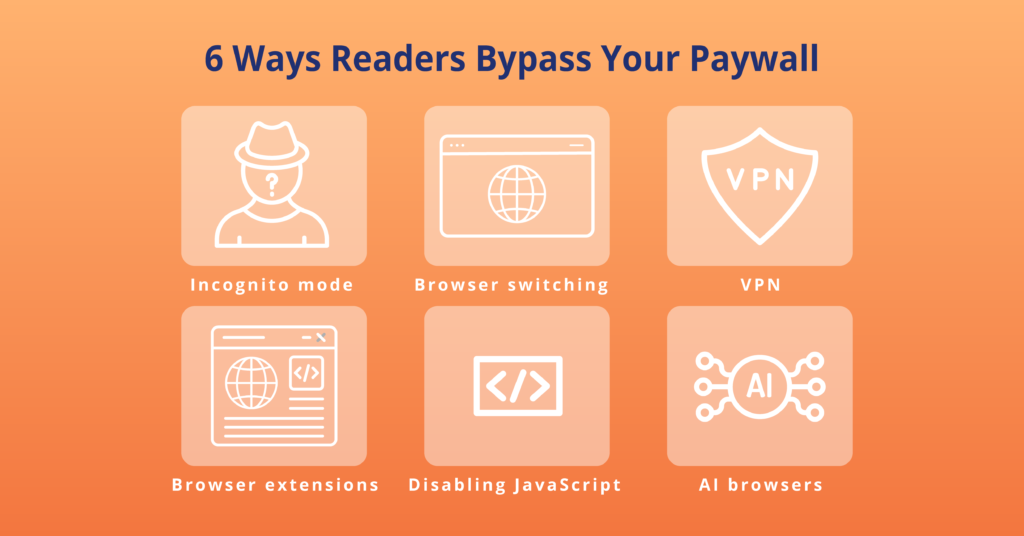
There is no single bypass technique. Most of the time, readers use several, often in combination. Understanding each one matters because each exposes a different weakness in how most paywalls are built.
Incognito and Private Browsing Mode
Opening a private tab starts a fresh browser session with no stored cookies, so a cookie-based meter simply resets. The reader looks like a brand-new visitor.
Switching Browsers
Someone who hits their article limit in Chrome just reopens the same piece in Firefox or Safari. No shared session data means the meter starts from zero again.
VPN Usage
A VPN masks the reader’s IP address, cutting off IP-based recognition across sessions. Paired with incognito mode, it makes traditional visitor identification close to impossible.
Browser Extensions and Archive Services
Tools like SMRY and archive.today exploit the fact that most paywall logic lives in the browser itself. Since the gating script runs client-side, it can be intercepted or stripped before it renders. Search interest in “bypass paywall” tools has doubled since 2021, according to Google Trends.
Disabling JavaScript
Disabling JavaScript works against paywalls that rely entirely on a JS overlay to hide content. No script, no wall.
AI-Assisted Access
AI browsers take a more sophisticated route. Users ask a tool like OpenAI’s Atlas or Perplexity’s Comet to read an article for them. The browser opens the page, reads the full content, and delivers it directly. The publisher’s server sees a regular Chrome visit. Blocking known AI crawlers does not help because these browsers do not identify themselves as bots.
Why Do Client-Side Paywalls Fail?
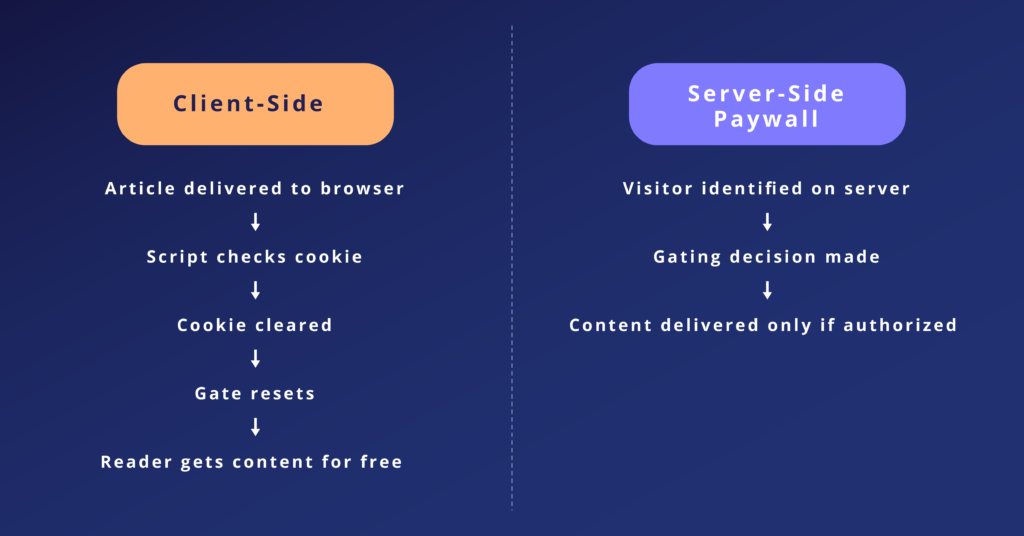
Client-side paywalls fail because they rely on enforcement in the browser, where users ultimately have full control over what gets loaded and executed.
This weakness explains why incremental fixes like better cookies or stricter session logic don’t actually solve the problem.
The Most Common Paywall Architectures
- A hard paywall blocks all content from non-subscribers at the server level, so no article is delivered without a valid session.
- A metered paywall gives readers a free article allowance, then gates after a set number. Most publishers use the metered model because it balances discovery with monetization. But nearly all metered implementations are client-side, which is where the vulnerability lives.
- AI browsers such as OpenAI’s Atlas and Perplexity’s Comet show up in site logs as regular Chrome sessions. Client-side overlay paywalls hide content visually, but AI agents read the underlying text regardless. What used to be a manual workaround for individual readers is now automated at scale.
Publishers can use the Robots Exclusion Protocol to block known AI scrapers, but AI browsers get around this by looking exactly like human traffic. Blocking them risks blocking real readers too.
A typical client-side paywall delivers the full article to the browser first, then runs a script that decides whether to display it or cover it with a subscription prompt. That decision is based on a stored cookie or session count. The reader controls the browser. Clearing the cookies, opening a private tab, switching browsers, or blocking the script causes the paywall to either reset or never load.
How Does Paywall Evasion Impact Revenue?
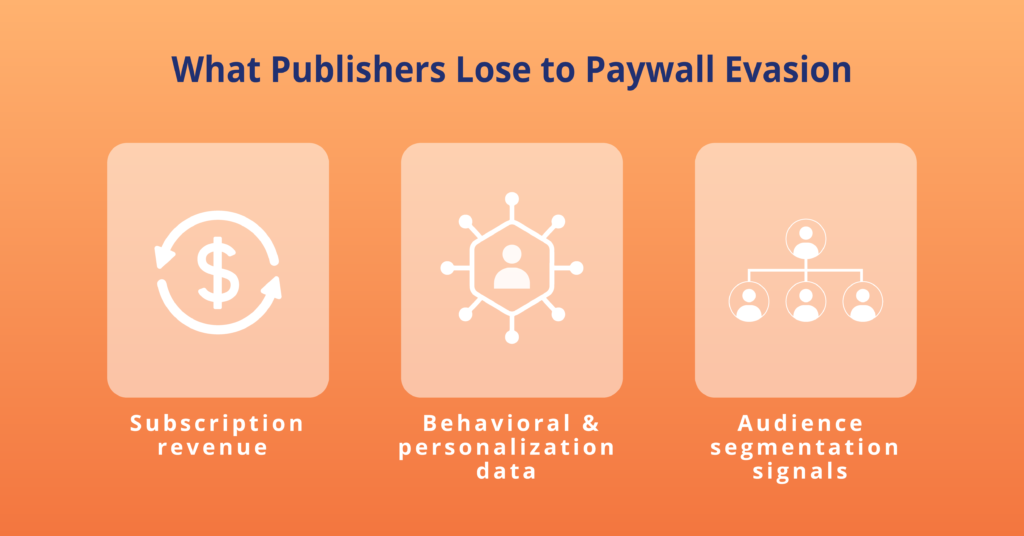
Paywall evasion hits revenue in two ways. The first is lost subscriptions. The second is distorted data: every bypassed session is a missing signal that weakens personalization, audience segmentation, and forecasting.
Subscription Revenue
According to research, only 1% of U.S. adults end up paying when they hit a paywall. With conversion windows already that narrow, losing 11% of paywall stops to evasion is a meaningful cut from an already limited pool of paying readers.
Behavioral data
Every bypassed session is also a missing signal. These readers are invisible in standard analytics, which means publishers lose the following.
- Personalization data on the readers most likely to convert or engage with premium content.
- Audience segmentation signals that feed targeted ad products and sponsorship tiers.
- Behavioral intent data that informs editorial strategy and content investment decisions.
The trend is moving in the wrong direction. Search interest in bypass tools has doubled over the past five years, and AI-powered browser agents are beginning to scrape paywalled content at scale, automating what individual readers used to do manually. For media platforms and publishers already under margin pressure, evasion turns into a data problem that keeps compounding.
How to Detect and Stop Paywall Evasion?
To detect and stop paywall evasion, you need to make it visible through server-side tracking and behavioral signals.
In standard analytics, a user who bypassed the paywall and one who simply left look identical. Both show up as non-converting sessions. Without deeper instrumentation, there’s no way to tell them apart.
Fixing that requires visitor recognition that holds across sessions, browsers, and privacy modes: something that survives cookie deletion entirely. Anonymous visitor tracking built on server-side fingerprinting does exactly that. Adenty’s identity resolution derives a stable visitor ID from device and network parameters on the server, making it independent of cookies. It recognizes returning visitors with up to 99% accuracy across incognito sessions, VPN connections, and privacy browsers, and identifies up to 3.2x more returning visitors than traditional tools.
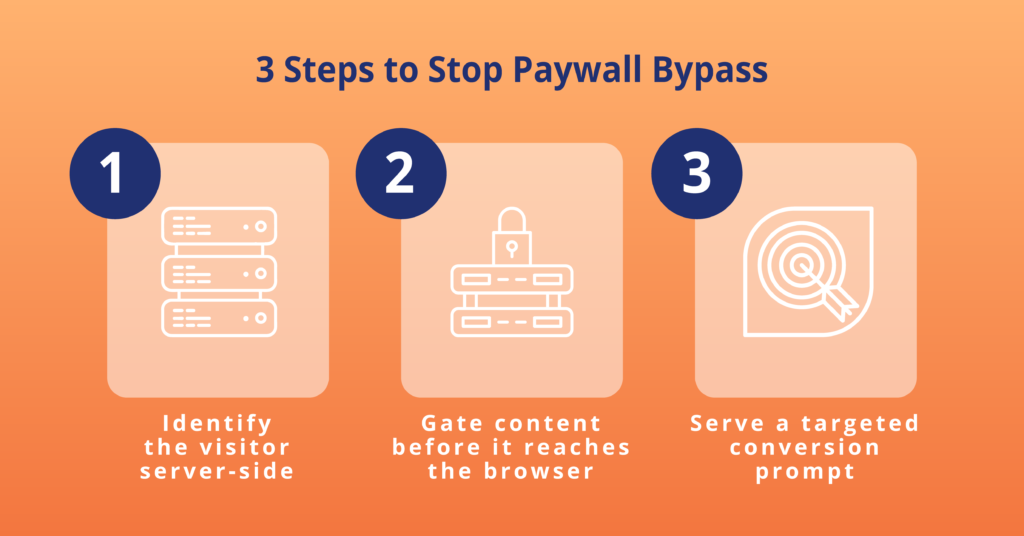
Once you can see evasion, stopping it comes down to three steps.
- Recognize the visitor before the page loads. The identity layer resolves who the visitor is server-side and passes that signal to the paywall logic before any content is delivered.
- Move the gating decision server-side. When the paywall fires before content reaches the browser, there is nothing for incognito mode, script blockers, or extensions to intercept.
- Treat evaders as a conversion segment. These readers visit directly, return frequently, and seek out premium content. Personalized prompts or limited-time offers aimed at known evaders convert at significantly higher rates than a generic meter message.
The conversion step looks different for every publisher. The most common approaches:
- Showing a personalized paywall message that acknowledges the reader has visited before.
- Offering a time-limited trial rather than a hard subscription ask.
- Triggering a targeted email capture before the full gate fires.
Each of these performs significantly better than a generic “you’ve used your free articles” prompt because the reader is already identified as someone with strong affinity for the content.
Adenty’s data activation layer handles multi-step engagement scenarios coordinated across your full MarTech stack. For publisher networks running multiple titles, cross-site visitor recognition ensures a reader flagged as an evader on one publication is handled consistently across the rest of the network.
What Results Look Like in Practice
The numbers on evasion rates are useful context, but what publishers actually need to know is what happens when you close the gap.
Stopping Evasion Across a 100-Publication Network
A media group running more than 100 newspapers and digital publications had readers routinely bypassing their metered paywall through incognito browsing and VPNs. In their standard analytics, those sessions showed up as new visitors with no consumption history, no evasion signal, and no way to act on them.
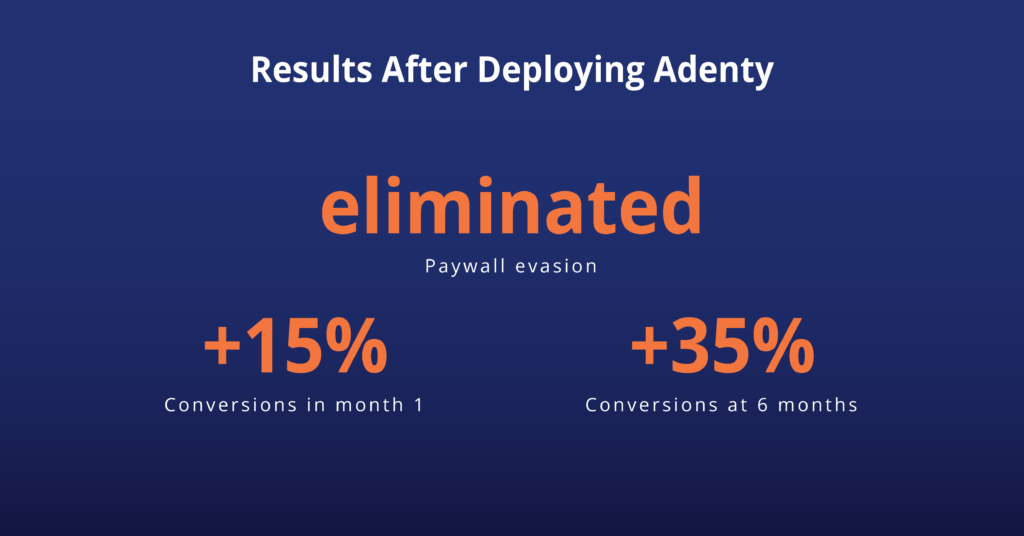
After deploying Adenty, readers who hit the article limit and reopened content in a private tab were recognized and shown the subscription prompt rather than a clean slate. Over 6 months, the network saw:
- Complete elimination of paywall evasion across the network.
- 15% increase in on-site conversions in the first month.
- 35% conversion growth at the six-month mark.
Recovering Invisible Returning Visitors
A separate regional publisher network ran a deeper audit of their visitor data after integrating Adenty. Cookie-based tracking had been missing 58.7% of returning visitors, counting them as new sessions on every visit. Those returning visitors converted at 31% higher rates than first-time sessions. Once Adenty’s server-side identification made them visible, the publisher gained actionable profiles on a segment that had been generating conversions all along, just without attribution.
The audit results:
- 2.7x more returning visitors identified compared to cookie tracking.
- 31% higher conversion rate among returning visitors versus new sessions.
- Recognition duration 2.3x longer across browsers and devices.
For both groups, the core problem was the same. The most valuable readers were invisible by default. Server-side identity made them visible and convertible.
Key Takeaways
The readers bypassing your paywall are your most engaged audience. With server-side identity, you can recognize them across incognito sessions, browser switches, and VPNs. When they hit the article limit and reopen the page in a private tab, they still see the subscription prompt. That’s how evasion stops.
Getting that identity layer right requires combining multiple signals: device parameters, network data, and behavioral patterns.
Adenty reaches up to 99% recognition accuracy across VPNs, incognito sessions, privacy browsers, and storage-restricted environments, whether you build on the API directly or use the out-of-the-box integration.
Book a demo and check out our plans to explore Adenty’s capabilities in anonymous visitor recognition, privacy-first tracking, and resilient data attribution. You can also start a 14-day free trial and see the results on your own audience before committing to a plan.
A survey found that 58% of digital publication readers regularly look for ways to access paywalled content without paying. That’s more than half your audience actively trying to get around the gate. The threat is also expanding beyond individual readers. AI bot traffic at publishers surged 300%, with media and publishing among the most targeted sectors. What used to be a reader behavior problem is now an automated one.
Private browsing is the most common individual method. Opening an incognito tab starts a fresh browser session with no stored cookies, so the meter resets and the site treats the visitor as new. AI browsers such as OpenAI’s Atlas and Perplexity’s Comet work differently: they show up as standard Chrome sessions, read content delivered to the browser, and return it to the user directly. Why does private browsing break paywalls?
The article loads before the gate fires. By the time the paywall script runs, the content is already in the browser. Clear the session data and the script has nothing to check against. The gate resets because the decision was never enforced at the server level.
Yes. The gate only engages for visitors the system already knows have hit their limit. Subscribers are recognized and passed through. New visitors get their free article allowance as normal. Nothing changes for legitimate readers because the identity check happens before content delivery.
Metered paywalls deliver content first and decide later. Hard paywalls verify credentials before sending anything. That sequence is everything. A reader who gets the article before the gate fires has already won, regardless of what the script tries to do afterward.
Adenty builds a stable visitor ID from device and network signals on the server. It does not depend on cookies or browser storage. The ID persists through private browsing, VPN use, and browser switches. By the time the page loads, the system already knows who is asking for it.
A study found that targeted offers shown at the paywall convert at 3.35x the rate of a generic prompt. Knowing who is evading is what makes that targeting possible. Evaders already know the content and return for it. The right offer at the right moment converts a reader who would otherwise stay invisible.
Yes. Server-side identity resolution does not rely on first-party cookies, third-party cookies, or any browser storage. It derives a persistent visitor ID from device and network parameters on the server, making it fully compatible with cookieless environments, privacy browsers, and consent-restricted settings.
Every bypassed session is an unattributed return visit. In standard analytics, those sessions inflate new visitor counts, deflate engagement rates for known readers, and remove behavioral intent signals from your segmentation model. Publishers running cookie-based tracking have been found to miss up to 59% of returning visitors, counting them as new on every visit.
Yes. AI browsers like OpenAI’s Atlas and Perplexity’s Comet present themselves as standard Chrome visits in server logs. Blocking via robots.txt or user-agent filtering does not stop them because they do not self-identify as bots. The only effective countermeasure is moving content delivery decisions server-side so the full article is never sent to unrecognized sessions.
Yes. Cross-site visitor recognition in Adenty links visitor IDs across domains. A reader flagged as a paywall evader on one publication is recognized as the same visitor on every other title in the network. Engagement and evasion history carries over, so conversion prompts are consistent and informed regardless of which property the reader lands on.
Traditional analytics platforms like GA4 count sessions and pageviews but lose continuity whenever cookies are cleared or a new browser is used. Anonymous visitor tracking uses server-side signals (device parameters, network data, behavioral patterns) to build a persistent visitor profile that survives cookie deletion, incognito sessions, and privacy mode. For paywalled publishers, this distinction determines whether evaders are visible or invisible.
