
Identifying Individual Website Visitors vs. Identifying Companies: What the Difference Costs You in Pipeline

What if almost every company evaluating your product visited your website… and you never knew it?
Prospective customers compare pricing, review technical documentation, evaluate integrations, and read customer references long before anyone schedules a demo.
67% of B2B buyers prefer to research suppliers independently and delay conversations with Sales until later in the evaluation process. For many companies, website activity appears weeks before the opportunity reaches the CRM.
A decade ago, most of this activity blended into anonymous web traffic. Marketing teams could measure sessions, page views, traffic sources, and conversions, but identifying the organizations behind those visits usually depended on a form submission.
Account identification changed that. Anonymous visits could be associated with known companies, giving revenue teams a way to recognize buying activity much earlier than before.
Company identification gives you a much sharper view than anonymous website traffic ever could. But as buying teams have grown, so have the questions revenue teams need to answer. That’s where the comparison begins.
How B2B Buying Changed
Looking for the decision-maker? You may need a bigger org chart.
Enterprise software buying is no longer a one-person decision. Engineering reviews implementation requirements. Security checks compliance. Procurement compares pricing and contract terms. Business leaders evaluate expected business outcomes.
Everyone comes into the buying process with a different job to do (and different priorities to focus on).
After surveying nearly 18,000 business buyers, Forrester found that buying groups continue to grow. Among organizations with buying groups of six or more people, 94% reported better purchasing decisions through broader collaboration.
Website activity often follows the same sequence.
| Week | Stakeholder | Primary activity |
| 1 | Engineering | Reviews APIs and implementation documentation |
| 2 | Security | Checks compliance and certifications |
| 3 | Procurement | Compares pricing and licensing |
| 4 | Business leadership | Reviews customer results and expected ROI |
| 5 | Project owner | Requests a product demonstration |
Viewed in analytics, these visits belong to one account.
Viewed as buying activity, each visit represents a different stage of the evaluation.
What Company Identification Is Designed to Do
For years, website analytics had one obvious limitation. You could measure sessions, page views, and conversions, but anonymous visitors remained anonymous unless they identified themselves by completing a form or logging in.
Company identification changed that.
When someone visits your website, every request leaves behind technical signals. Depending on the platform, these may include the visitor’s IP address, browser metadata, timestamps, referral source, and navigation patterns. Those signals are combined with commercial IP intelligence, reverse IP lookup, firmographic databases, and proprietary matching models to estimate which organization generated the visit.
It’s worth noting that this isn’t a simple IP-to-company lookup. Modern platforms continuously validate and enrich their data, filtering out residential networks, cloud providers, VPN traffic, and other sources that can reduce matching accuracy.
The result is not just a visitor’s identity, but a specific account.
Depending on the provider, the available information typically includes:
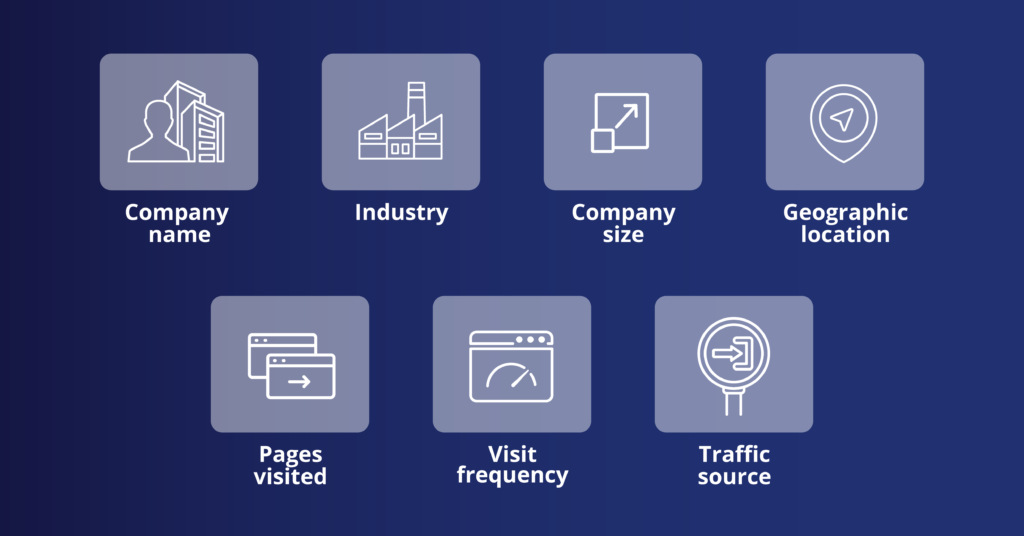
Many platforms also enrich account records with CRM data, marketing automation platforms, firmographic profiles, or third-party intent data. That gives revenue teams additional business context while keeping the company as the primary unit of analysis.
- For Marketing, this means seeing which target accounts engage with campaigns and content before they convert.
- For Sales, it means recognizing organizations researching a product before the first conversation.
- For RevOps, it means tracking account activity across campaigns, territories, and pipeline.
That’s why company identification became a standard part of account-based marketing. It turns anonymous website traffic into identifiable accounts, giving any department a shared view of which organizations are actively researching a solution.
Where Account-Level Visibility Reaches Its Limit
Now imagine that the same account returns to your website over the next few weeks.
The activity keeps growing. More product pages are viewed, more technical resources are downloaded, and more time is spent comparing solutions.
From an account perspective, everything looks positive. What you can’t tell is how that activity is distributed.
- Is one engineer doing all the research?
- Has the security team started its review?
- Has procurement joined the evaluation?
- Has an executive become involved before the budget discussion?
The insights gained change how Marketing and Sales interpret buying intent.
Company identification isn’t missing information because the technology failed. It was designed to answer one question:
Which organization is showing interest?
Modern B2B buying introduces another one:
Who’s participating inside that organization, and what role are they playing in the evaluation?
42% More Direct Bookings.
Same Website.
This hotel network didn’t buy more traffic. They recognized who was already interested and acted before competitors could.
See How It WorkedWhat Individual Visitor Identification Adds
Individual visitor identification approaches the same website activity from a different angle.
It attempts to connect activity to the professionals participating in the buying process.
The underlying technology is more than another IP lookup. Depending on the platform, it combines first-party behavioral data, identity graphs, consented business profiles, browser and device signals, authentication events, and identity resolution techniques to determine whether multiple visits belong to the same professional.
The identified individual can then be associated with a company, role, and previous interactions. As a result, decision-makers get a much clearer view of how buying activity develops inside an account.
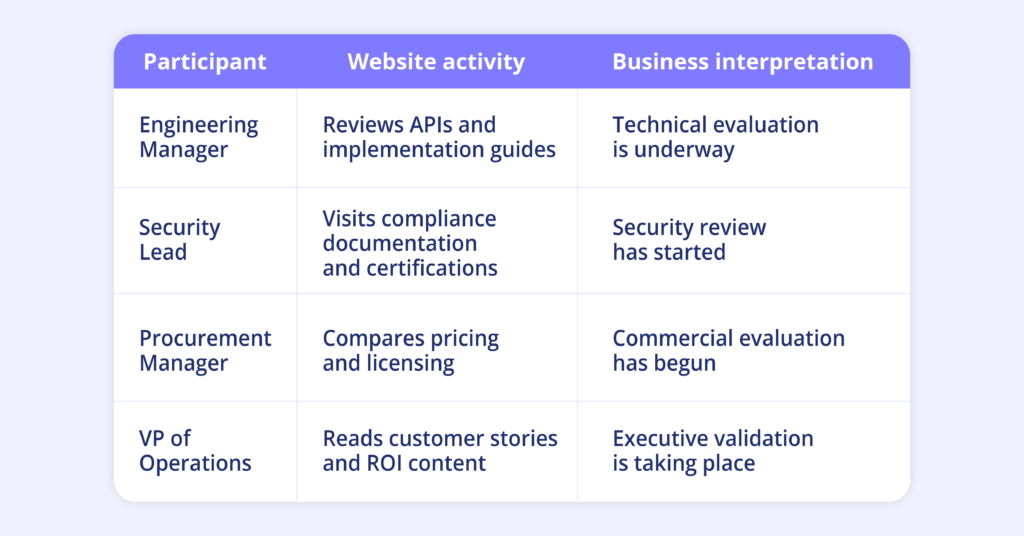
Instead of seeing that “Microsoft visited your website”, you begin to see how the evaluation is unfolding inside Acme.
That changes the conversation from account activity to stakeholder participation.
Marketing can understand which audiences engage with different content. Sales can recognize when new decision-makers enter the buying process. RevOps gains a more accurate picture of buying committee growth instead of treating all website activity as a single stream of account engagement.
How Individual-Level Data Fits Into Revenue Operations
Website activity influences decisions long before someone requests a demo. The real question isn’t whether that early activity matters – it clearly does – it’s what a team is supposed to do with it once it’s captured.
The honest answer is: not much, if it’s only recorded at the company level. Structuring that activity around individuals makes it usable for prioritization, timing, and follow-up. Here’s what that looks like in practice.
Prioritizing Accounts
Not every active account deserves the same attention.
One account might show a single visitor returning to technical documentation over several weeks. Another might show activity from Engineering, Security, Procurement, and business leadership within a few days.
Both accounts are “active” by any company-level metric. But one reflects a lone researcher; the other reflects an organization actively evaluating a purchase.
Telling those two apart requires more than a list of page visits. It requires knowing that the same handful of people are returning, and who else has started showing up alongside them. That’s the difference between tracking a company and tracking the people inside it over time.
Choosing When to Engage
Buying activity doesn’t stay static. It changes as an evaluation progresses.
A typical sequence looks something like this:
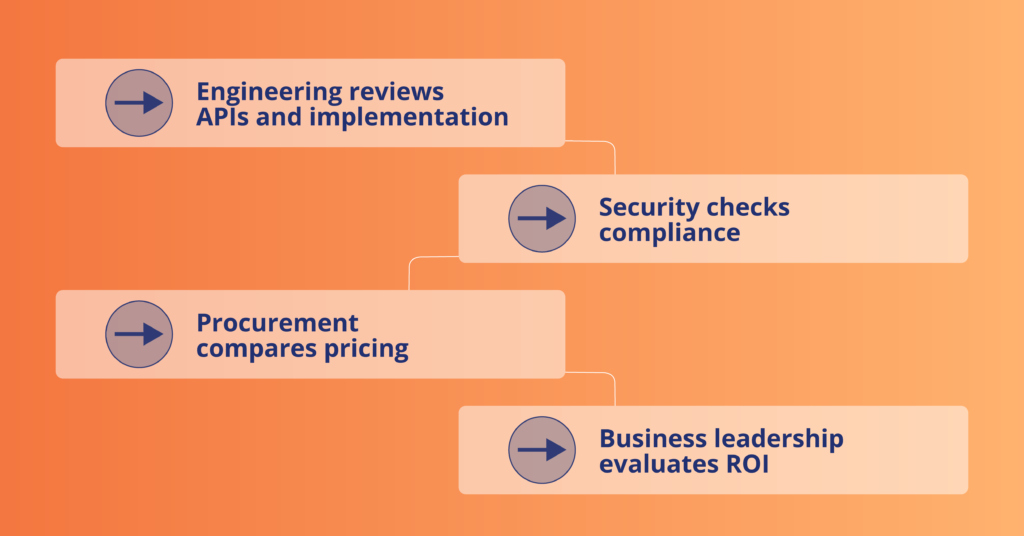
Watching that sequence unfold gives a team a clearer sense of whether an account is still in early research or approaching a vendor conversation.
Timing matters just as much as accuracy. If that information arrives after the visitor has already left the site, it’s useful for reporting, but much less useful for deciding what to do next.
Adenty resolves visitor identities while the session is still active, allowing CRM, marketing automation, or sales alerts to react before the visitor leaves the website.
Understanding Buying Committee Coverage
Enterprise deals rarely move forward on the strength of one department alone.
Knowing which functions have already engaged – and which haven’t shown up yet – gives account teams a rough map of the buying committee before the first discovery call, instead of piecing it together during the conversation itself.
It also surfaces gaps. If Procurement and Security have been active but no one from the business side has, that’s useful to know before a proposal goes out, not after it stalls.
Because visitor profiles persist across sessions, Adenty shows when new stakeholders begin participating instead of treating every visit as an isolated event.
Personalizing Follow-Up
Different stakeholders are looking for different information.
An engineer reading API documentation isn’t asking the same questions as someone comparing pricing or reviewing customer outcomes. Their interests usually reflect the role they play in the evaluation.
A follow-up becomes more relevant when it reflects that context:
- Engineering: APIs, architecture, implementation guides
- Security: Compliance documentation, certifications, security controls
- Procurement: Pricing, licensing, contract terms
- Business leadership: Customer outcomes, ROI, implementation timelines
Role, company, browsing history, and previous engagement become available through connected marketing and sales platforms, making role-specific follow-up practical instead of manual.
Evaluating Individual Visitor Identification
Not every organization needs the same level of visitor intelligence. The right approach depends on how your teams sell, how many stakeholders typically participate in a deal, and how early buying activity influences revenue decisions.
When evaluating visitor identification platforms, look beyond basic company matching.
Consider questions such as:
- Can visitor identities persist across multiple sessions, devices, and websites?
- Is identity resolution performed while the visitor is still active?
- Can visitor profiles be enriched with CRM, firmographic, and behavioral data?
- Can identified visitors be activated immediately through CRM, marketing automation, or sales workflows?
- Does the platform work reliably in a privacy-first, cookieless environment?
These questions focus less on feature lists and more on whether the data can support day-to-day decisions across Marketing, Sales, and RevOps.
Is Individual Visitor Identification Right for Your Business?
Company identification changed how revenue teams understand website traffic by connecting anonymous visits to organizations.
Individual visitor identification builds on that foundation. It connects those visits to the people participating in the evaluation, making it easier to recognize buying committee growth, understand stakeholder participation, and respond while an evaluation is still underway.
That’s the approach Adenty was built around.
If you’d like to see how that works with your own website traffic, book a demo with the Adenty team and explore how individual visitor identification fits into your existing revenue workflow.
