
How to Identify Returning Shoppers and Hotel Visitors Without Cookies

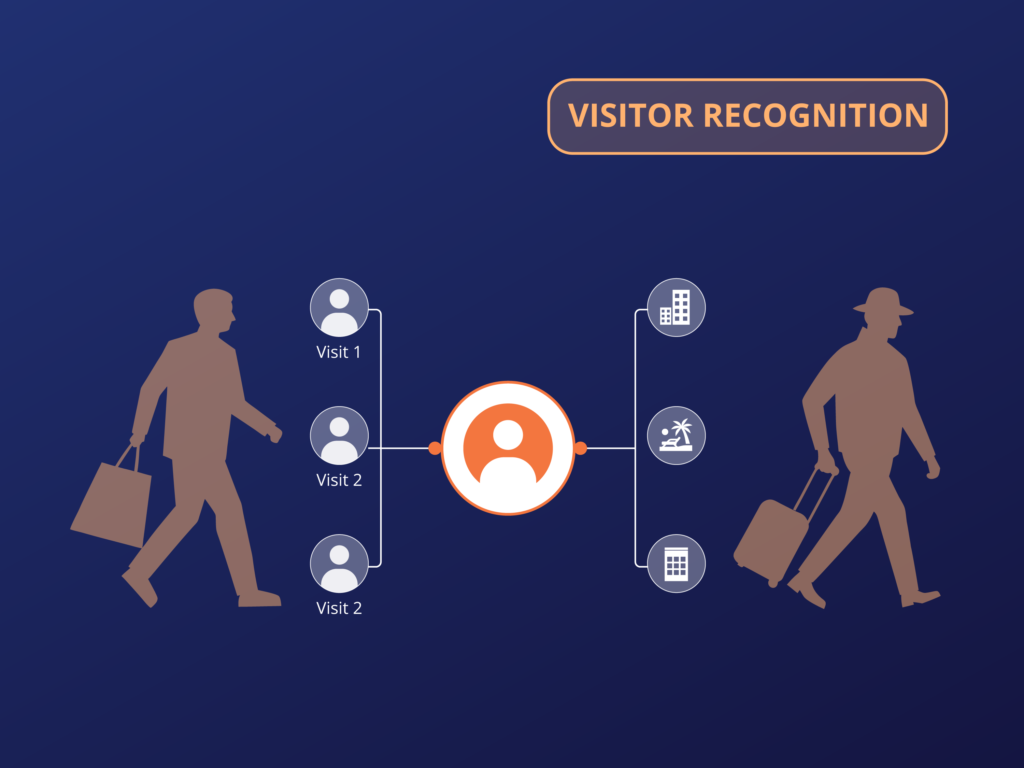
A shopper opens a product page in October, closes the tab, and comes back on a different phone a week later. A business traveler scouts a hotel from a laptop at the office, then books from the lobby of a competing property. In both cases the person on the second visit is the same person as the first. In most reports they appear as two new strangers.
Browser cookies and local storage fade fast. People switch devices mid-decision. Mobile apps strip the referrer on the link they just opened. The common cost is the same across retail and hospitality: a returning visitor who looks like a cold lead, a message tuned for a stranger, and an on-site action that fires at the wrong moment, if it fires at all.
This guide is a working answer to that question. It covers the signals that identify returning shoppers and hotel visitors without third-party cookies, the on-site actions that move conversion on the current visit, and the result pattern teams see once identity is resolved and tied to a live offer.
Why Do Returning Shoppers and Hotel Visitors Keep Looking Like Strangers?
Classical analytics stacks lean on the browser cookie as the identifier. The cookie expires, gets wiped by a privacy-focused browser, or stays with one device while the person moves to another. The result in the dashboard is a new session for the same visitor and a thin profile for every segment that depends on returning behavior.
Several ongoing shifts amplify the gap in 2025 and 2026. Chrome kept third-party cookies in place after a long policy review, which the Chrome team summarized in a mid-2025 Privacy Sandbox update, yet first-party storage and Safari and Firefox limits continue to shorten the cookie lifetime most sites actually see. In-app WebViews on mobile open links in isolated storage, drop the referrer, and show up in Direct traffic. AI-driven answer tools send people to a product page without a classic search session behind the click.
For retail and hospitality specifically, the extra pressure is the long comparison window. Shoppers compare before Prime Day and holiday periods; hotel guests scout a destination for weeks before booking. The buying journey is spread over sessions, devices, and sometimes over cities. One cookie cannot stretch that far.
What Does This Cost in Shopper Retention?
Cart abandonment is the cost most retail teams can read in their own data. Industry work on the pattern, including the long-running Baymard Institute cart abandonment benchmarks, places the rate near seven in ten carts across sectors. A returning shopper whose history is lost looks like a new high-intent visitor and gets the welcome message, not the targeted recovery offer, which is one of the clearest ways identity blur turns into lost revenue.
What Does This Cost in Hotel Bookings?
Hotel properties feel the same problem through the OTA versus direct split. A guest reads property pages across devices, compares the rate on the hotel site to the rate on the OTA, and books where the next step is easiest. If the hotel site does not recognize the second visit, the pricing message, the loyalty prompt, and the local availability call-out all land as if the visitor arrived cold.
How Do You Identify a Returning Shopper Without Third-Party Cookies?
Cookieless identification stitches a visitor from the signals that stay stable across visits, not from a cookie that resets. Adenty assembles the identifier from device fingerprints, server-side observations, deterministic linkages where available, probabilistic matching, and partner-side enrichment. Recognition for the resulting persistent ID reaches up to 99%, including in Tor, Brave, VPN sessions, and sessions where storage has been cleared.
Which Signals Carry a Shopper Across Visits?
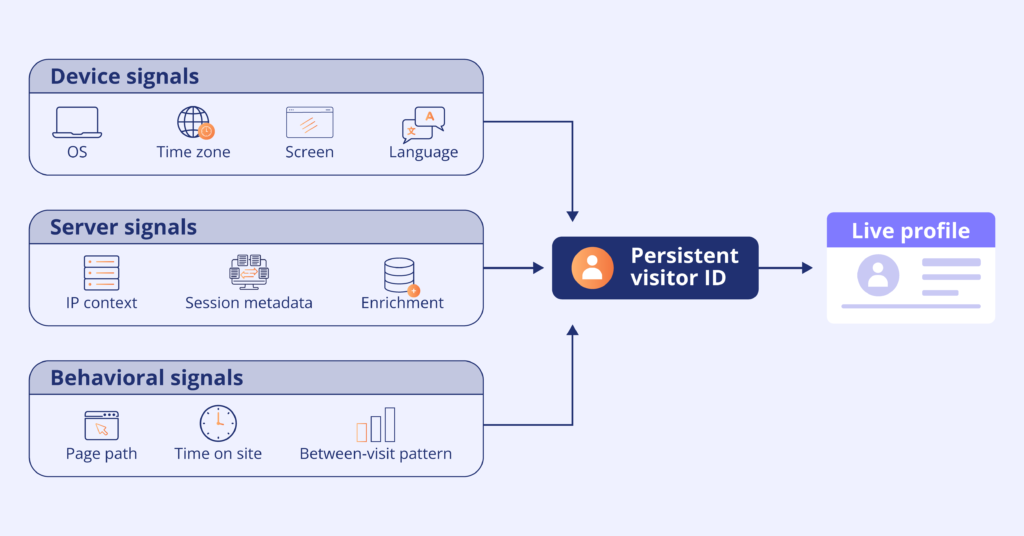
Three signal classes do most of the work. Device-side signals describe the hardware and software context in a way that stays consistent between visits on the same machine. Server-side signals, captured on the Adenty side, hold identifiers that no browser action can wipe. Behavioral signals, including the path the shopper takes through the catalog, add context that a reset cannot destroy.
The pattern that matters for retail is cross-visit continuity: the second time a shopper opens the same product, the system knows it is the same shopper and attaches the prior session’s intent to the new one. That continuity is what turns a repeat view into a trigger for a targeted offer rather than a repeat welcome banner.
How Does Cross-Device Tracking Work for Modern Shoppers?
Cross-device linkage uses the same identity graph, with device-linking signals layered on top. A phone and a laptop that share enough contextual signals, including login patterns or deterministic matches through connected services, are tied into one profile. The practical outcome is one visitor record for a shopper who browsed on a phone during a commute and finished on a laptop at home.
How Do You Identify a Hotel Visitor Across Sessions and Properties?
Hospitality adds a second axis to the problem: the same guest often visits several properties in one chain. The identity layer needs to hold across time and across sites.
Adenty supports cross-site visitor identification by default. The persistent ID stays with the visitor as they move between properties on different domains in the same group. A guest who checked rates at a city-center property on Monday and opened a resort property on Thursday is recognized on the second site as the same person, with the same context attached. The platform’s hospitality use case page walks through the setup for property groups.
What Keeps Identity Stable When a Guest Switches Devices?
The identity graph is storage-independent. It survives cleared cookies, incognito mode, VPN use, and the private browsers that frequent travelers often prefer in airports and hotels. Device-linking signals bind the laptop at the office to the phone at the hotel lobby to the tablet at home.
For a hotel marketing team that question matters because the booking decision rarely happens on one device. A booking engine that recognizes the returning guest can pre-select the destination, show the loyalty tier, and present the right rate without asking the visitor to repeat anything they already told the brand.
Why Measurement Alone Does Not Lift Conversions
Counting more sessions is useful. By itself it is not revenue. A dashboard that recognizes the second visit does not, in and of itself, add a booking or a cart recovery. The business question underneath is which of those recognized visits can you act on while the visitor is still with you.
Most activation platforms in common use today react after the event has been written to a queue. The queue flush usually completes after the shopper closes the tab or the hotel visitor hits the back button to the OTA. The chance to influence the current decision is gone.
How Do You Activate a Shopper or Hotel Visit in Real Time?
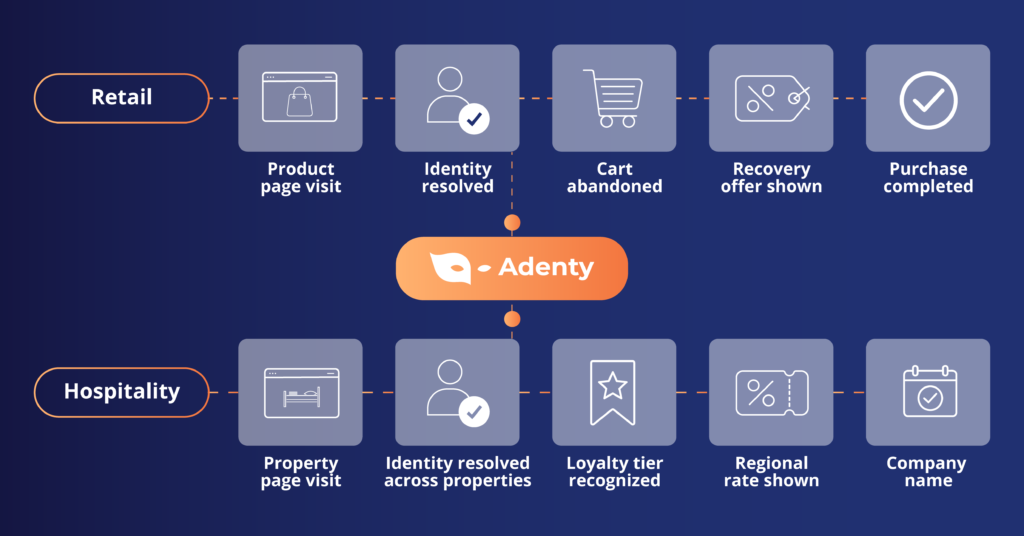
Session activation acts on the live profile while the browser is open. The response takes the form that fits the vertical: a modal with a recovery offer for a cart that has been abandoned twice in a row, a region-aware rate for a hotel visitor who is comparing properties in the same city, a chat prompt tailored to a product category, a paywall for an identified publisher audience, or a custom call wired in through JavaScript or an API.
Adenty consolidates signals, resolves identity, and builds the live profile that these actions read from. Teams layer the actions through the data activation modules, which fire on signals captured during the current session rather than yesterday’s segment.
Which On-Site Actions Lift Conversion the Most for Retail?
For retail, the actions that consistently move conversion are the ones that react to live intent. A contextual chat that opens on a repeat pricing view hits a visitor who is already deciding. A localized price that updates to the shopper’s region removes a reason to leave the page. A recovery offer tied to an identified returning shopper outperforms the generic welcome banner by a wide margin on an identity-aware stack.
In controlled trials, personalized on-site actions tied to identity-based targeting have added as much as 50% in conversion over the untargeted baseline, according to results documented in the Adenty FAQ. In one Adenty case, cart abandonment dropped by 13% and the retailer recovered $2M in revenue once buyer signals, profile data, and live session triggers were layered into the checkout path.
Which On-Site Actions Lift Direct Bookings for Hotels?
For hospitality, the actions that move the needle are the ones that remove friction on the second visit. A returning guest sees the destination they searched a week ago as the default. The loyalty tier populates automatically. The local availability or a city-level campaign fires at the moment the visitor is comparing properties.
In one hotel-network rollout, direct bookings climbed by 20% once identity was resolved for returning guests and on-site offers started firing in real time. The lift came from the combination: recognition on the second visit plus an action during that visit, not either half on its own.
What Results Look Like in Practice
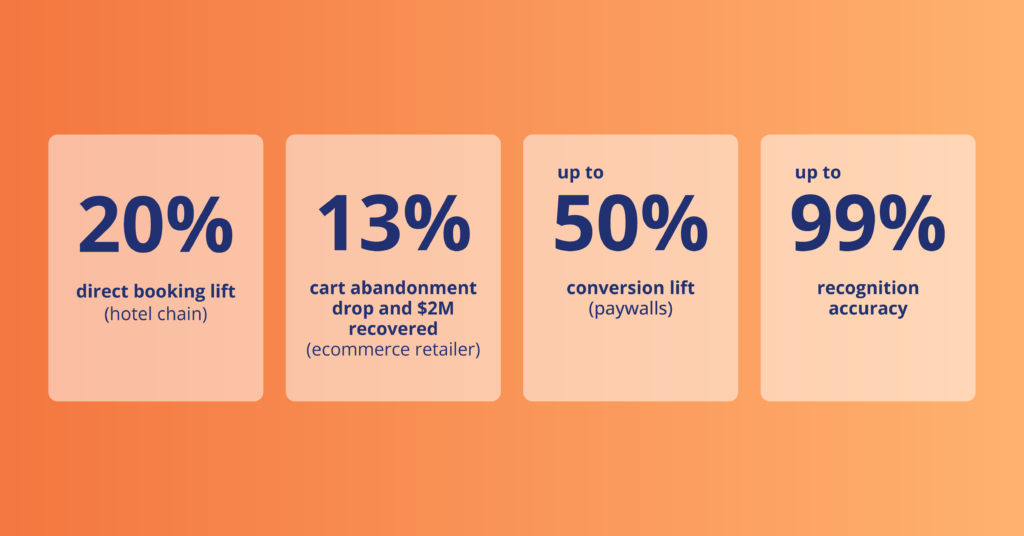
Numbers from real Adenty deployments trace a repeatable pattern.
• A hotel chain lifted direct bookings by 20% after identity was resolved for returning guests and on-site offers started firing in real time.
• An ecommerce retailer trimmed cart abandonment by 13% and recovered $2M in revenue after buyer signals, profile data, and live session triggers were layered into the checkout path.
• A publisher expanded remarketing reach from 5% to 95% once the previously anonymous share of traffic became recognized and reachable.
• A media account grew conversions by 35% and eliminated paywall evasion once anonymity-resistant recognition and paywall enforcement were switched on together.
• A SaaS funnel added 120 net-new sign-ups and 45% more conversions after leads were ranked by resolved identity rather than by raw page visits.
Analytics review documented in an Adenty case study logged 2.7x the number of returning visitors recognized versus the control, 1.6x stronger overall recognition, and a window of recognition 2.3x longer than cookie-based or IP-based approaches. A DMP in a parallel review doubled profile depth and tripled the audience it could address once storage-independent tracking took over.
How Does Adenty Fit Into a Retail or Hospitality Stack?
Adenty does not replace the shop system, the booking engine, the CRM, or the ad platform. It sits as a plugin layer on top of them. Enriched visitor signals move into GA, BigQuery, CDP, and CRM. So, the dashboards the team already uses stay in place while the identity underneath them improves.
The setup follows the sequence the problem calls for: recognize, understand, convert. Six modules carry it, and recognition is only the first. Identity resolution recognizes each visitor across sessions, sites, and devices, and persistent storage keeps a durable data store linked to that visitor. Data collection captures live behavior, data enrichment unifies the profile with data from any source, and behavioral analysis reads current intent against past visits. The last module, AI-driven activation, chooses the best action at the right moment to drive conversion. AI builds that strategy around the site’s own traffic: real visitor behavior and the business context, not a generic template.
A typical rollout fits in a 10 to 30 minute install window and asks nothing beyond basic technical familiarity. The install comes in three shapes: an HTML snippet pasted into the site template, a tag through Google Tag Manager, or a white-label JavaScript file hosted under the client brand.
What Adenty Does for Shoppers and Hotel Visitors
• Carries one persistent visitor ID across visits, devices, and domains, so a returning shopper and a returning guest both stay the same person in your data
• Rebuilds stable identity in cookieless contexts, including Tor, Brave, VPN, and cleared-storage sessions, with recognition topping out at 99%
• Lifts the counted pageview total by as much as 30% over GA4 by holding identity steady between visits
• Streams enriched signals in real time into the destination CDP, into BigQuery, into GA, and into any storage reachable through an API
• Fires on-site responses, chat, offers, region-aware pricing, loyalty prompts, while the visit is still open
• Supports GDPR consent modes, lets you pin storage to a region, and on the Enterprise plan deploys inside your own Azure tenant
Key Takeaways
• A shopper or hotel visitor returning on a different device looks like a stranger in most dashboards. The cost shows up as missed recovery offers for retail and missed direct bookings for hospitality.
• Cookieless identification stitches a persistent ID from device signals, server-side observations, deterministic links, probabilistic matching, and partner enrichment. Adenty reaches up to 99% recognition accuracy, including in locked-down browser contexts.
• Measurement is only half the job. Session activation acts on the live profile while the browser is open, through chat, region-aware pricing, loyalty prompts, and recovery offers.
• Published Adenty results include a 20% direct-booking lift for a hotel chain and a 13% drop in cart abandonment with $2M recovered for an e-commerce retailer.
• Adenty sits as a plugin layer on top of the existing stack. The install fits in 10 to 30 minutes and streams enriched signals into analytics, CRM, and ad platforms through a public JavaScript object and API.
Next Steps
Walk through how identity moves across properties on the hospitality page or how it ties into the checkout path on the ecommerce page. Review the full catalog of real-time triggers on the data activation module. Compare the Adenty pricing plans, which scale by pageviews rather than by seats, and then try Adenty free or book a 30-minute demo with your current recognition rate for returning visitors.
A retargeting pixel sits in cookie storage, so the signal resets when the browser clears cookies, when the shopper moves to a new device, or when a privacy-focused browser blocks third-party scripts. A storage-independent identifier combines device, server, and behavioral signals, so the same shopper stays linked across visits even when the pixel is gone. Match rates on identified returning visitors stay closer to 99% as a result.
Yes. Adenty supports cross-site visitor identification by default, so a persistent ID stays with the guest as they move between properties on different domains in the same group. A guest who checked rates at a city property on Monday is recognized on a resort property on Thursday with the same context carried over.
Recognition reaches up to 99% in restricted browser environments, including Tor, Brave, and sessions where the user cleared storage before arriving. The identifier is assembled from device fingerprints, server-side observations, deterministic linkages, probabilistic matching, and partner-side enrichment, so no single storage mechanism is a point of failure.
Context-aware chat on a repeat pricing view, region-aware pricing, and recovery offers tied to an identified returning shopper tend to produce the biggest lift. In controlled trials, personalized on-site actions tied to identity-based targeting have added as much as 50% in conversion over the untargeted baseline.
Published Adenty results include a 20% direct-booking lift for a hotel chain after identity was resolved for returning guests and on-site offers started firing during the active visit. The outcome came from both halves of the setup: cross-visit recognition plus a live action tied to it, not either half alone.
No. Adenty sits as a plugin layer on top of the stack already in place. Enriched signals move into GA, BigQuery, the destination CDP, the CRM, the booking engine, and the ad platforms through a public JavaScript object and an API endpoint, so the dashboards and funnels marketing and operations already run on stay unchanged.
Yes. The platform ships with consent-mode support, opt-in controls, and the option to pin storage to a specific region. Infrastructure runs on Microsoft Azure with primary servers in Germany and the US, and Enterprise customers can deploy Adenty inside their own Azure tenant to keep every piece of visitor data within a private boundary.
For most sites the initial rollout fits in a 10 to 30 minute window and asks nothing beyond basic technical familiarity. The install comes in three flavors: an HTML snippet, a tag through Google Tag Manager, or a white-label JavaScript file hosted under the client brand. Enterprise rollouts with custom authentication or enrichment can run from a few hours up to a couple of days.
Compare the share of recognized returning visitors and the conversion rate on that segment before and after enabling Adenty. The platform computes both metrics automatically, and the team can help pin down the tracking setup so the pre-rollout baseline and the post-rollout result are genuinely comparable in your reporting layer.
